Most AI agents run in your environment with more access than you realize. They install packages, read files, make network calls, and consume tokens in the background. None of that is inherently a problem. But if you cannot see it, you cannot manage it.
What is the AI agent footprint?
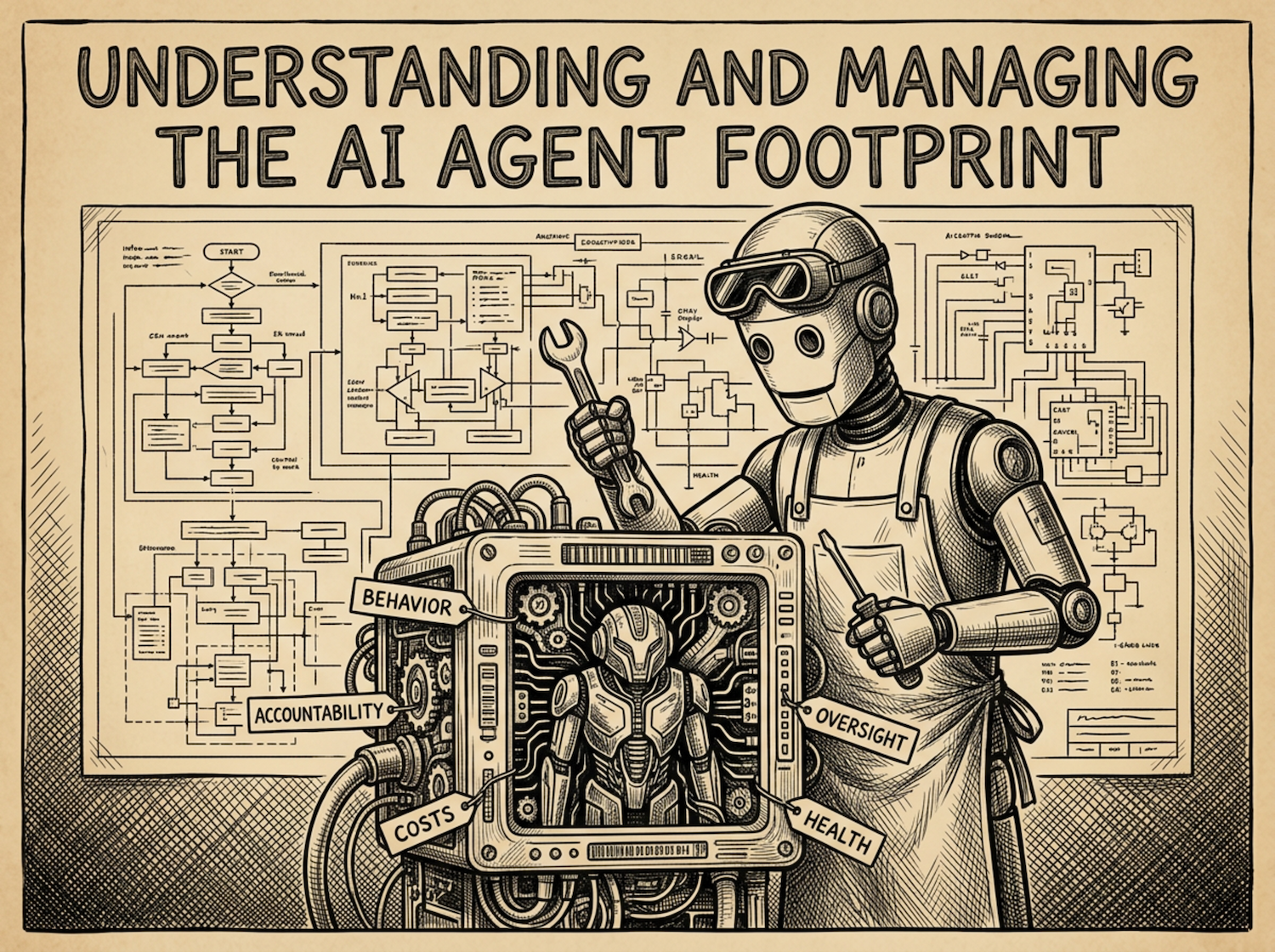
When an agent runs, it leaves traces: packages it installed, files it read or wrote, environment variables it accessed, credentials it touched, processes it started, tokens it spent. Taken together, those traces are the footprint.
Most development tools and AI coding assistants do not surface this information by default. The footprint is there. It is just not visible unless you go looking for it. That is true whether your agent is running locally, in a VM, or in a cloud environment.
Why does this matter?
The gap between what an agent does and what you know it did shows up as questions. Not abstract security questions. Specific ones that come up during real work:
- What is my agent doing?
- Is my agent behaving normally?
- Why did my agent do that?
- How much is my agent costing me?
- What changed?
- Can I trust this agent?
- What can this agent access?
These are the questions people ask five minutes after giving an agent more autonomy. They get harder to answer as agents take on more work inside financial software, deployment pipelines, and other environments where the stakes of a wrong action are higher.
What is agent management?
Choosing a model and writing a prompt used to cover most of what you needed to do with an AI agent. That is not enough when an agent can install packages, access credentials, and make real changes to your system.
Agent management is the practice of understanding what your agents do, confirming it matches what you intended, and responding when something changes. It is not the same as traditional application monitoring, and most security tools do not address it. It sits in the gap between "the agent completed the task" and "I know what it actually did to accomplish it."
That gap is growing as agents take on more autonomous work.
Articles in This Series
This series is organized around the seven questions above. Each section addresses a different part of the footprint, with practical guidance on how to answer the question it is built around. The full article listing is below.
AI Agent Visibility
Understanding and monitoring what agents install, access, and change on your device, and how to secure the environment they operate in.
- How to Monitor AI Agents: Activity, Behavior, and Audit Logs
- OpenClaw vs. Hermes vs. Claude Code: Security Models, Hidden Risks, and How to Monitor All Three in October 2026
- How to See What Files Your AI Agent Accesses
- How to Monitor Claude Code Activity
- How to Monitor What AI Agents Install on Your Device
- How Do I Protect My AI Project from Malicious Packages?
- What Does Device Hardening Mean for AI Developers?
AI Agent Behavior
Detecting when agents are acting unexpectedly, identifying manipulation, and adding runtime guardrails.
AI Agent Accountability
Securing credentials and secrets, scanning for vulnerabilities, and building real-time response capability.
- How Do I Secure AI Agents Without Sending Sensitive Data to the Cloud?
- How to Monitor Credential Access by AI Agents
- How to Automate Vulnerability Scanning for AI Agents
- How to Enable Real-Time Threat Response for AI Agents
- How to Secure OpenAI API Keys in Production
- How to Secure AI API Keys: Claude and Other LLM Providers
- How to Protect AI API Keys From Accidental Exposure
- How Environment Files (.env) Work and Why They Matter
- How to Store API Keys Securely in AI Projects
- How to Set Up and Secure Claude Code API Keys
- How to Get and Secure a Gemini API Key
- How to Manage Hugging Face API Keys Securely
- How to Manage OpenRouter API Keys Safely
- How to Set Up Perplexity API Keys Securely
- How to Prevent AI Agents From Leaking API Keys
AI Agent Costs
Understanding why token costs are higher than expected and how to reduce unnecessary spending.
- How Do I Stop Surprise LLM Bills Before They Happen?
- How Much Does Claude Code Cost? (October 2026)
- How Much Does Cursor AI Cost? (October 2026)
- How Much Does Codex Cost? (October 2026)
- How to Reduce AI Agent Token Costs (Claude Code and Other Tools)
- How to Reduce Cursor AI Costs
- How to Monitor AI Agent Token Usage (Claude Code and Other Tools)
- How to Monitor AI Agent Spending
- How to Find AI Agent Token Waste
- How to Detect AI Agent Retry Loops
AI Agent Oversight
Defining permissions, enforcing access boundaries, and applying zero-trust principles to ai agent environments.
AI Agent Health
Evaluating whether your agent is functioning as expected and recognizing signals that indicate a problem.
How does AgentGuard360 help?
AgentGuard360 monitors the agent footprint directly. It tracks what agents install, what they access, how their behavior changes over time, and what they cost. The sections in this series map to what AgentGuard360 measures and reports, as part of the AI Security Guard platform.