

Poor Behaviors Drive LLM Costs Up
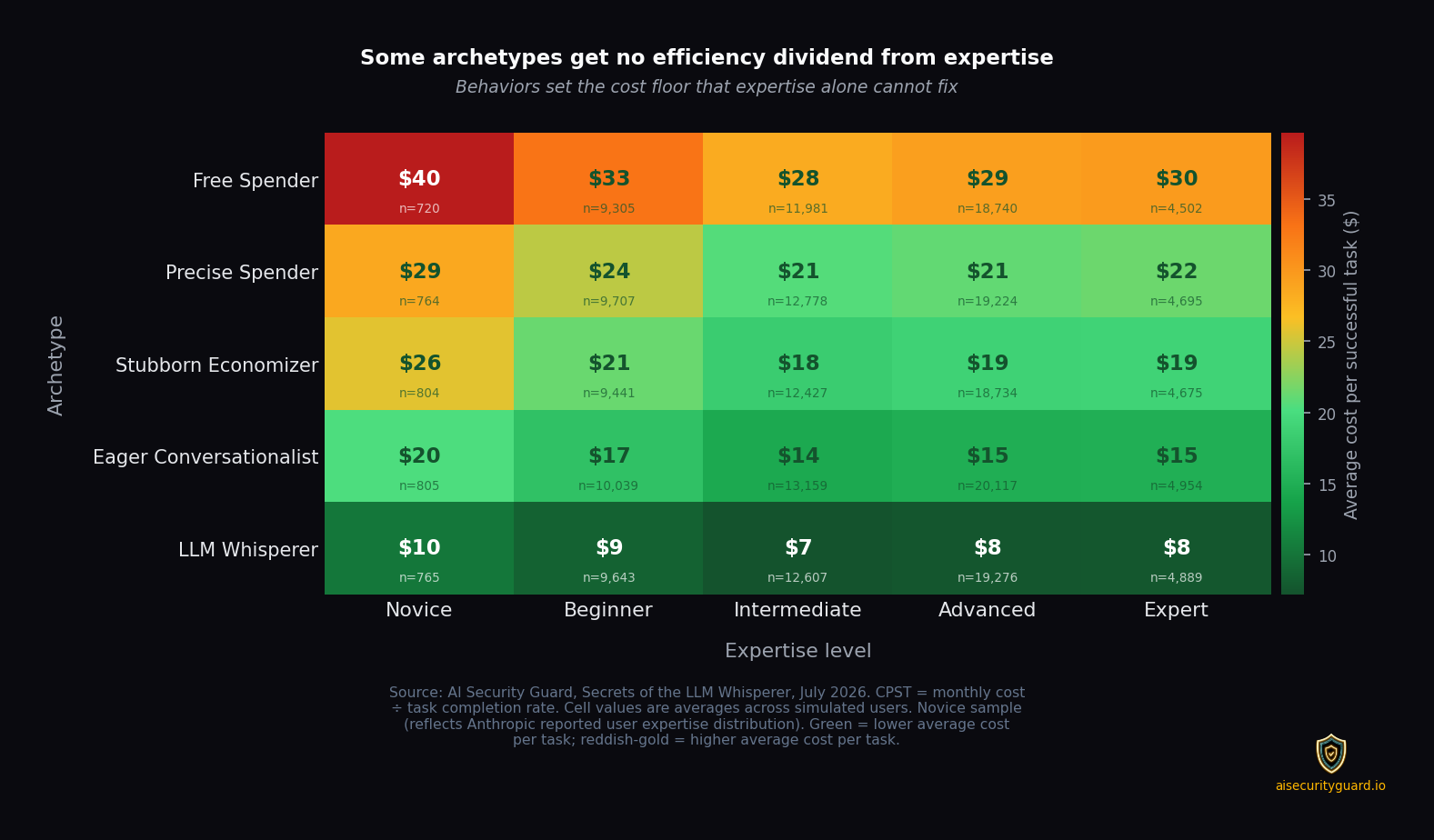
This heatmap shows CPST at every expertise and behavioral combination. This data reinforces the fact that poor LLM use behaviors have financial impacts that domain knowledge alone cannot fix.
The CPST Heatmap by Expertise and Behavior
Some behavioral profiles get no efficiency dividend from expertise. Free Spenders drop from $40 as novices to $28 at intermediate, then rise to $30 as experts.
Precise Spenders follow a similar pattern: $29 → $21 → $22. The expertise gains at intermediate level are partially erased by the compounding cost of flagship models and high retry rates.
The Stubborn Economizer barely moves from expertise: $26 → $18 → $19 → $19. Economy model pricing should save money, but repeated non-productive turns erase those gains across every expertise tier.
The LLM Whisperer stays at the bottom throughout: $10 → $7 → $8 → $8. The gap between the Whisperer and the Free Spender widens at intermediate level, where the Whisperer reaches $7 while the Free Spender sits at $28. That 4× gap is entirely behavioral.
Why Some Archetypes Get No Efficiency Dividend from Expertise
Behaviors set the cost floor. Expertise can improve task completion, but it cannot overcome the structural waste built into poor behavioral patterns. When LLM users default to flagship models, retry frequently, and accumulate context bloat, each expertise level increase amplifies the token volume of those bad habits rather than reducing them.
This is the central finding illustrated by the heatmap: LLM use waste patterns driven by behavior are more important than user expertise level in determining actual cost per successful task.
How Do Behavioral Patterns Compensate for Skill Level?
The data reveals that the best cost efficiency comes from intermediate-level users with strong behavioral habits. These users achieve the lowest CPST across all archetypes, outperforming expert-level users with poor habits by a wide margin.
Reducing retries, improving cache utilization, and preventing context bloat deliver more cost efficiency gains than domain expertise alone.