

Running a Local LLM? Time is Money
People running local LLM models might assume that implementing behavioral optimization techniques does not matter. Hardware is paid for, electricity is an ongoing expense and there are no limits on token use, or token budgets.
But, local LLM users also pay a cost from poor habits: their time.
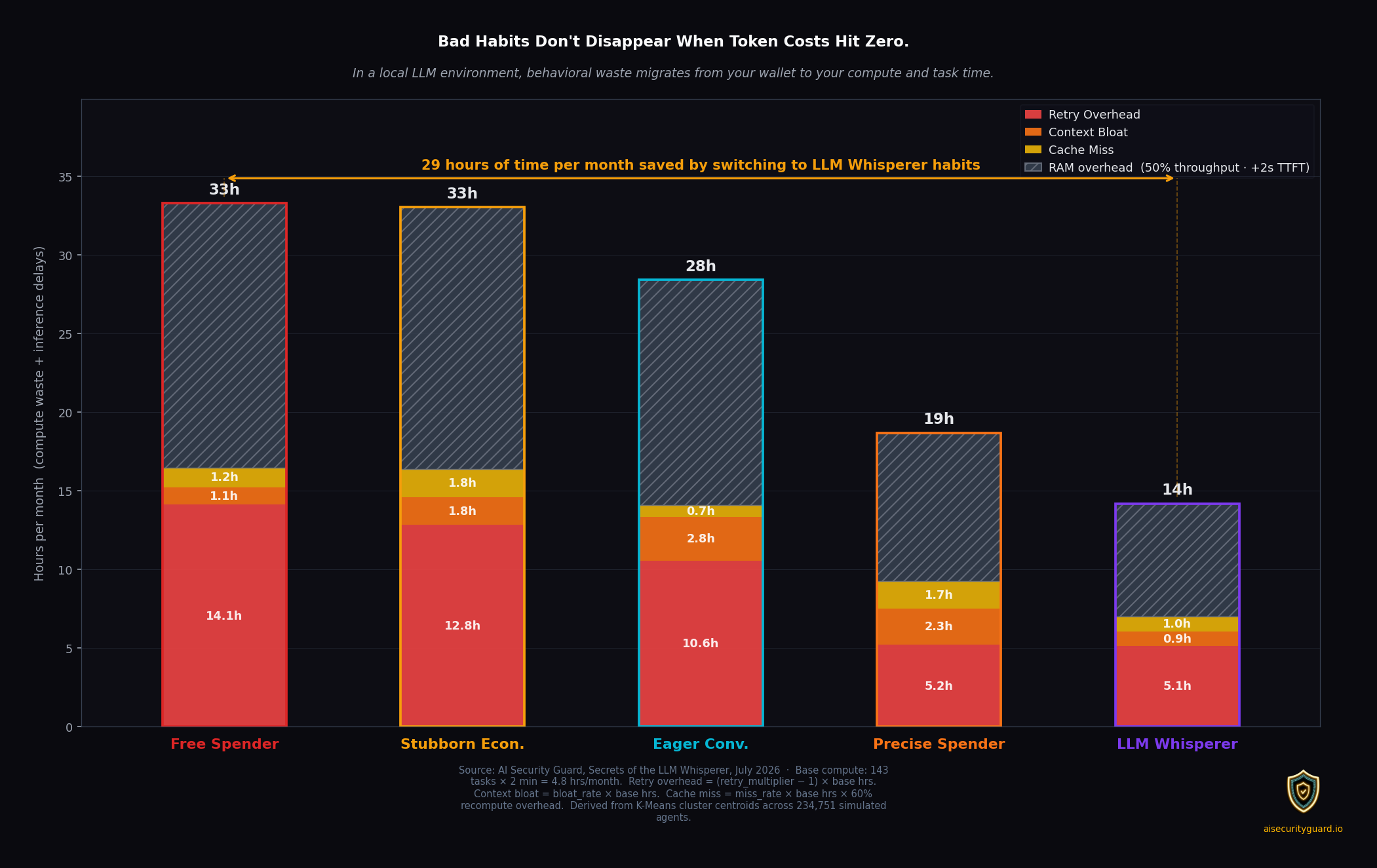
The simulation measured wall clock time wasted by poor behaviors across all five archetypes. The chart shows hours per month lost to local LLM agent retry overhead, context bloat, cache misses, and RAM-constrained inference delays.
LLM Whisperers spend 14 hours per month on wasted compute and inference delays. Free Spenders spend 33 hours. The difference — 19 hours of wasted time — comes from the same behavioral patterns that drive higher costs in premium cloud API environments.
To conduct this analysis, behavioral data about each archetype uncovered during the simulation was converted into time metrics. Base compute was calculated at 143 tasks per month with an average of 2 minutes per task (a highly efficient user).
Retry overhead is the extra hours from repeated attempts beyond the minimum. Context bloat is the fraction of each inference wasted on redundant tokens. Cache misses are estimated at 60% recompute overhead per miss.
Why Local LLM Agent Looping Still Costs Time
Even on local hardware, AI agent loops waste resources. What does it mean when an AI agent is stuck in a loop? This is when agents repeatedly try to complete the same action, due to a programming error or another factor.
The consequence of AI agent loops is lost productivity. When a local LLM agent gets stuck in a retry loop, compute cycles are still consumed. The time spent waiting for inference is also lost. The difference is that instead of paying a cloud provider, the user pays with their own time.
For those using local LLMs models (and running local LLM agents), token costs are not "zero." They represent time spent completing tasks. In the worst case scenario, users could waste almost a day (or more) of time by not being disciplined about their LLM use.
In Resource-Constrained Environments the Cost of Inefficiency Compounds
Many people seek to run the most powerful and capable models they can on their hardware. This can mean contending with lower throughput and longer time-to-first-token rates.
In these circumstances, practicing good LLM use habits becomes even more important. Retries take longer to recover from, contaminated context has a bigger impact. Local LLM looping can be especially costly because the hardware constraints mean each retry consumes more wall clock time than it would on a cloud API.
How to Reduce Local LLM Time Costs
The behavioral patterns that drive cost in cloud environments increase time waste in local LLM environments. The same five variables discussed elsewhere in this reasearch, retry rate, cache behavior, context bloat, prompt overhead, and model sizing, determine how efficiently local LLM model workflows run.