Less Expensiove LLM Models Are Good Enough for Most Tasks
The Opus 4.5 release was a turning point in how people thought about what LLMs could do. The model was noticeably more powerful and intuitive.
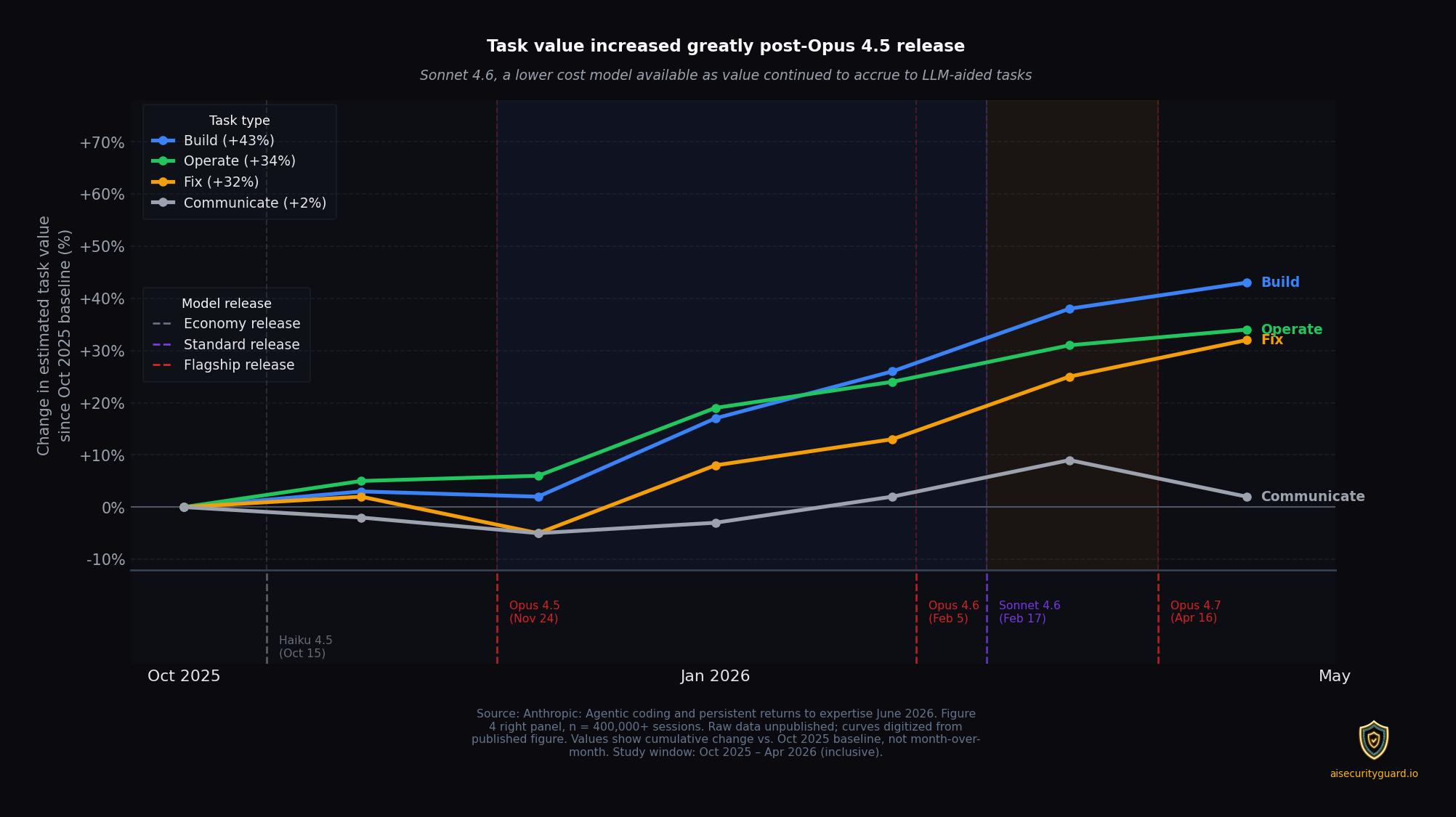
What the data indicate is that task value grew significantly starting in early 2026, which aligns with increasing adoption of Opus 4.5. People began tackling more complex and valuable work because Opus was available.
But the Opus release also had a side effect. People got used to defaulting to the most powerful models for tasks because each model release represented a significant jump in capabilities.
However, today the world is very different from when Opus 4.5 was introduced. Anthropic released Sonnet 4.6, a standard-tier model that is appropriate for most tasks. In addition, powerful open source models, as well as those from other labs, like OpenAI, are now available.
Another consideration is cost. As AI labs increase pricing for more expensive models, users will have to make strategic decisions about what models to use for various tasks. Lowering cost per successful task is important. If less powerful, but capable models can do the job, that makes it easier to realize LLM cost savings, justify LLM spending and maximize financial and economic benefit.
How Model Selection Affects AI Agent Token Costs
Anthropic classified what people use Claude Code for into nine work modes. The four most common are: "building something new", "fixing something broken", "operating software", and "communicating via ... prose-based documents." These modes span a wide range of complexity, from summarizing and answering questions (low complexity) to building new software from scratch (high complexity).
For example, low-complexity communicate tasks could use roughly 30,000 tokens on average. High-complexity Build tasks might use roughly 820,000 tokens — nearly 27× more. Not all tasks are created equal, and the cost impact of model selection depends heavily on the type of work being conducted.
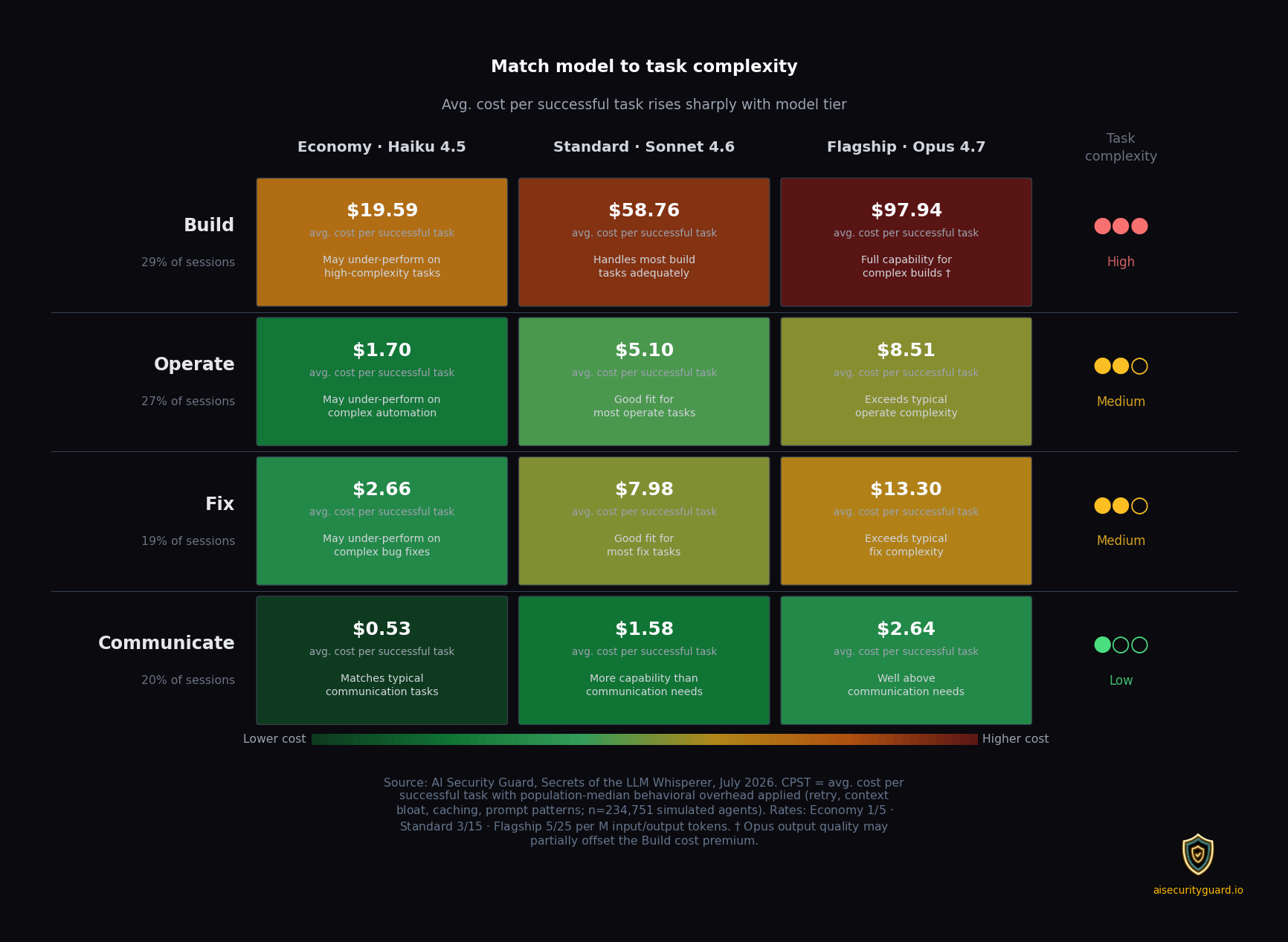
To measure this impact, CPST was computed for each task type across three model tiers in the simulation: Economy (Haiku 4.5), Standard (Sonnet 4.6), and Flagship (Opus 4.7). Published June 2026 token rates for each model tier were used. For this analysis, behavioral overhead (retry patterns, context bloat, caching, prompt patterns) was held constant using population-median levels from the full simulation of 234,751 agents. This was done to isolate the impact of model choice on CPST from behavioral differences in token consumption.
The results show that model selection has a significant impact on LLM cost savings and CPST across task types regardless of complexity. Flagship models cost 5× more than Economy for Communicate tasks, and 5× more for Build tasks.
For low-complexity work, Opus 4.7 delivers output that is well above what is needed to complete the task. In this situation, the extra model capability does not justify the extra cost.
The Cost Impact of Using Flagship Models for Simple Tasks
Using the right model for the job is a measurable cost lever that directly impacts CPST. Flagship models like Opus 4.7 deliver exceptional quality on complex tasks, but for routine work, such as summarization, code review, simple quality assurance tasks, standard or economy-tier models deliver comparable results at a fraction of the cost.
The key insight from the simulation is that model tier × task complexity creates a two-dimensional cost landscape. Users who optimize only along one dimension (picking expensive models for simple tasks, or cheap models for complex tasks) may leave significant economic value on the table.