

How You Use AI Impacts Your LLM Costs
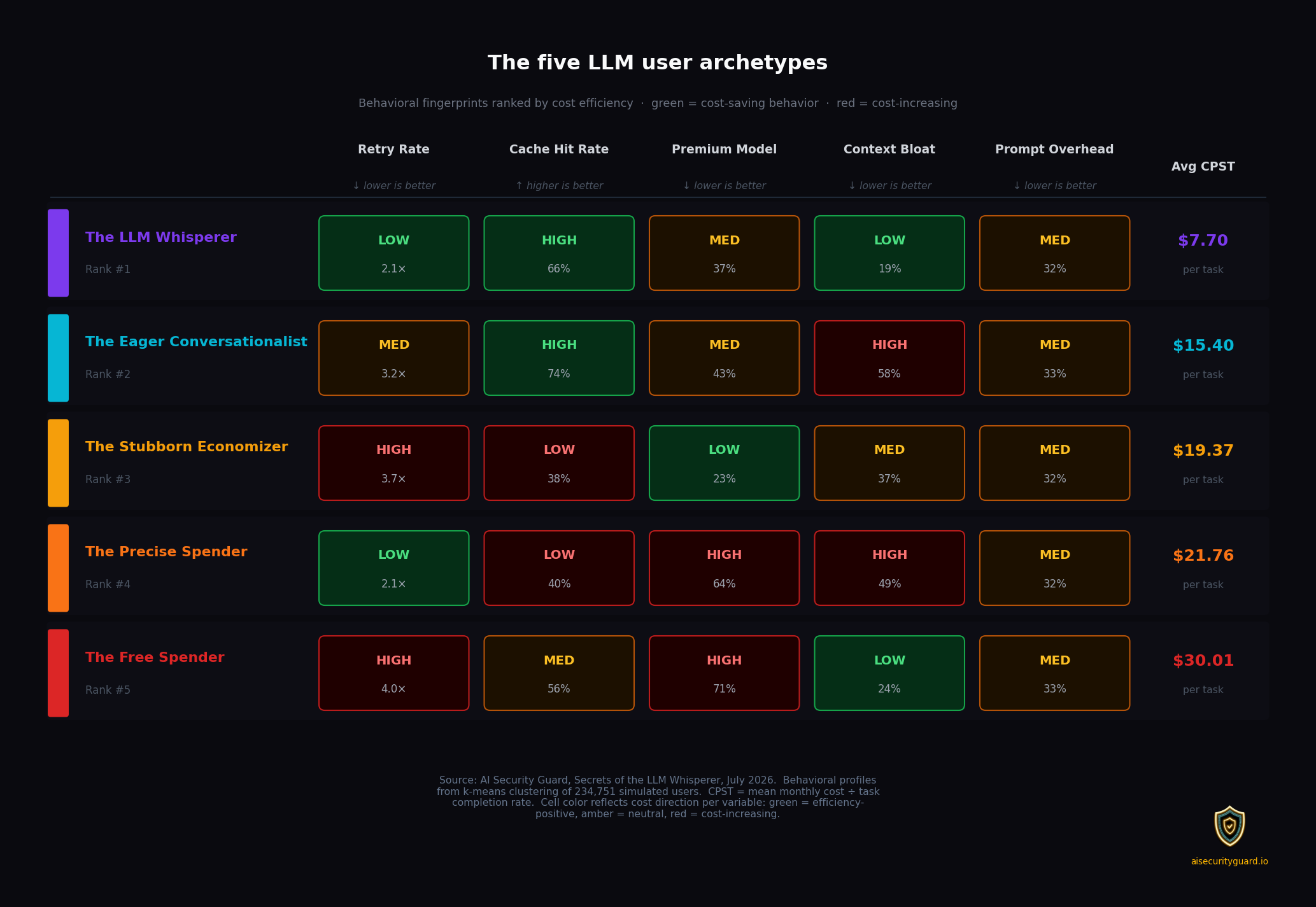
The behavioral simulation surfaced five distinct LLM user archetypes. Each represents a pattern of choices (and LLM agent cost efficiency behavioral impacts) in the areas of model selection, retry behavior, cache habits, context management, and prompt discipline combined into a recognizable user type.
The Five AI Agent Behavioral Archetypes
The LLM Whisperer is the most LLM cost-efficient profile. Average CPST: $7.70. They write clean prompts, avoid retries, manage session caches well, and default to mid-tier models. Their advantage comes from habits that compound: fewer turns result in less bloat, which leads to better cache utilization and lower input costs.
The Eager Conversationalist keeps conversations active and achieves the highest cache coverage of any profile. Average CPST: $15.40. But their verbose, less optmized sessions accumulate context bloat, and trigger higher retry rates, which partially cancels out their caching advantage.
The Stubborn Economizer defaults to economy-tier models, which should keep costs low. Average CPST: $19.37. But they lose those savings through repeated, non-productive turns when sessions go wrong.
The Precise Spender writes well-constructed prompts, which results in low retry rates. Average CPST: $21.76. Their spending is driven by expensive LLM model choices and low cache utilization.
The Free Spender combines the two highest-impact cost behaviors: flagship model pricing and high retry rates. Average CPST: $30.01. This illustrates how expensive models and poor session discipline compound.
Why Behavioral Cost Differences Matter
The cost gap between the Whisperer and the Free Spender is 3.9×. The gap is driven entirely by behavior. A novice with good LLM use habits can achieve a lower LLM cost per token over time than an expert with poor behaviors.
The Most Cost-Efficient AI Agent Behaviors
The LLM Whisperer profile demonstrates that using cheaper models and writing precise prompts is an important component of effective AI cost optimization. However, working to optimize every behavioral dimension is also critical. Fewer wasted turns, better cache utilization and less context bloat are beneficial LLM use behavioral patterns that can create compounding cost savings over time.
Understanding which behaviors are most effective will require using LLM cost tracking solutions optimized to measure CPST. But doing so will be well worth the effort.