
Efficient LLM Users Can Deliver More Economic Value
CPST measures cost, but there is another side of the equation. Each successful task also has an economic value related to the work. This can be additional revenue, improved health outcomes or other benefits.
Calculating AI Agent Return on Investment
In its research, Anthropic approximated the economic value of LLM-assisted work by looking at what it might cost on the freelance marketplace. By this measure, Anthropic found that the "estimated value of the average session rose by 27% between October [2025] and April [2026]."
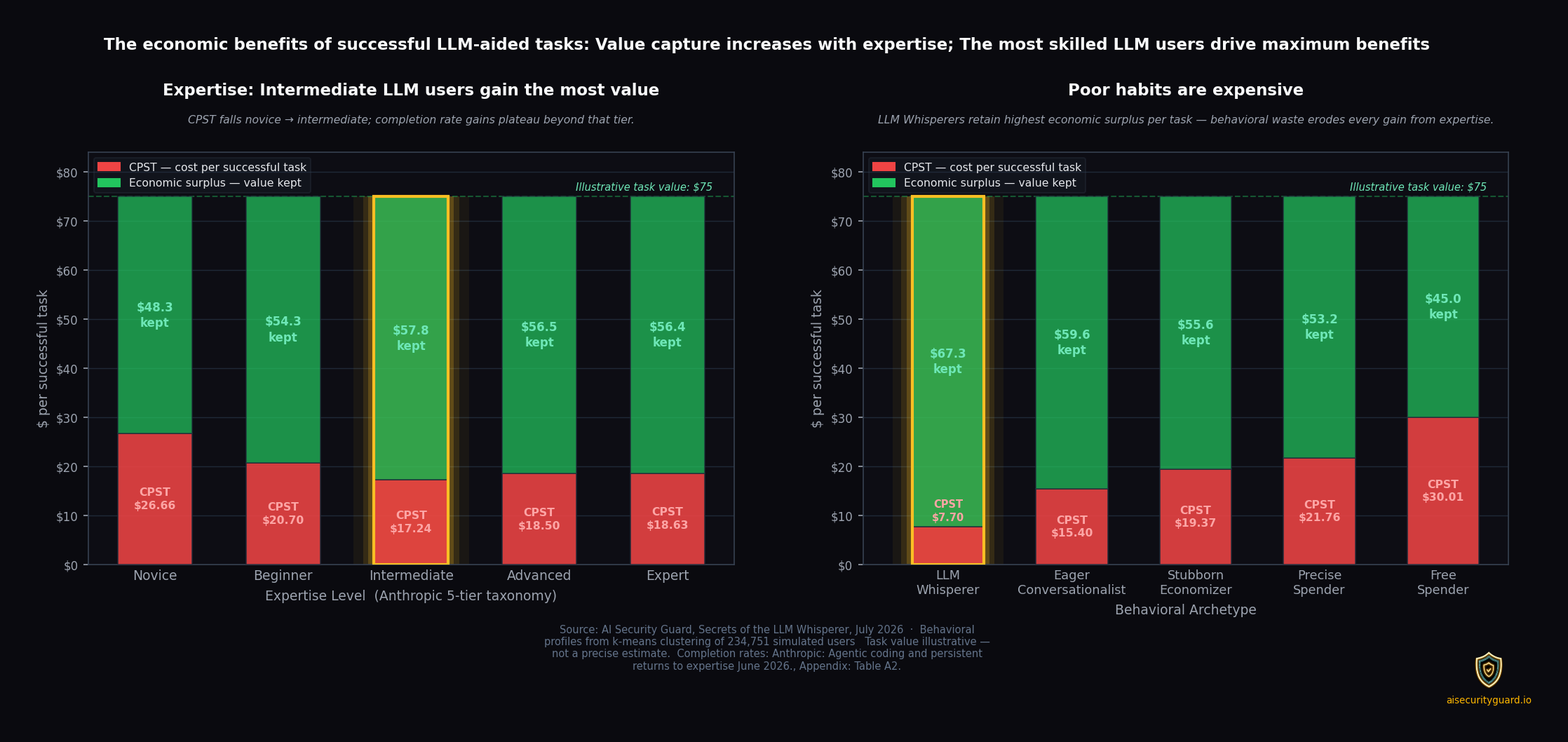
To better understand the potential economic benefits of successful tasks, using CPST as a measure, post-simulation, a hypothetical economic value per successful task of $75 was assigned.
The results of this economic analysis reveals something important about the relationship between expertise and economic benefit. Intermediate users capture the most economic surplus at $57.80 per task. Beyond intermediate level, the gains flatten. Advanced and Expert users retain roughly $56.50 and $56.40 of economic benefit respectively, almost identical to intermediate.
Why Behavioral Efficiency Drives AI Agent ROI
But LLM use behavior matters more than expertise. The LLM Whisperer captures $67.30 in economic surplus per task, which is more than experts at $56.40. Behavioral efficiency provides more upside than the expertise gains from intermediate to expert. A novice LLM Whisperer can produce more economic value than an expert with poor habits.
The Free Spender reveals what happens when bad habits accumulate. CPST reaches $30.01, which is higher than a novice's $26.66. Expertise does not offset expensive behavioral choices. Selecting the most expensive models, significant retries, and missed cache hits drive up CPST past the point where even expert-level success rates can compensate.
Economic benefit may come from two sources:
- Expertise, which improves task completion rates (at least up to the intermediate level)
- Behavioral discipline, which may keep the cost of each successful task low
Maximum benefit comes from combining both.