Prompt Stuffing is Often a Bad Idea
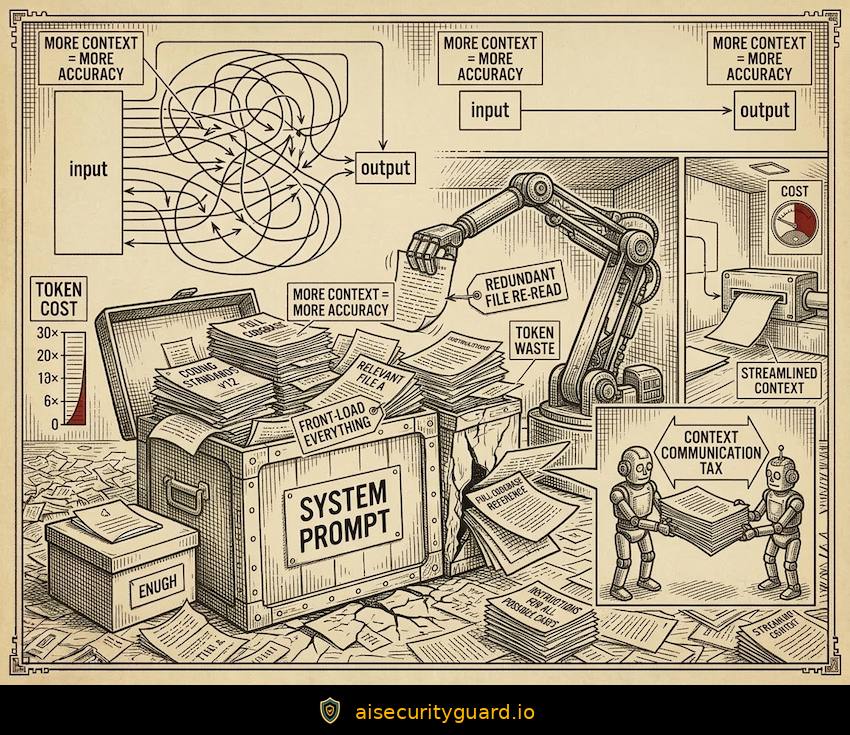
A common piece of advice for working with AI agents is to pack as much context as possible into every prompt: load the entire codebase, paste every relevant file, include exhaustive coding standards, and give the agent "everything it needs to know." The logic seems sound. More information should mean better guidance and higher accuracy.
The data shows the opposite. In their analysis of agentic token consumption, Bai and colleagues found that tasks consuming more tokens are actually less accurate, not more. The same task can vary by up to 30x in total token consumption across runs, with the most expensive runs being the failed or stuck ones, not the successful ones. Larger context does not reduce the odds of redundant file re-reads, stale instructions, or other failure modes. It simply makes each failed attempt more expensive.
The problem compounds in multi-agent workflows. Research on agentic software engineering shows that input tokens outweigh output tokens by approximately 53%× on average, with the majority of tokens spent on context communication rather than novel output. When agents pass large contexts during collaboration, the majority of tokens are spent on moving context around rather than generating it. The "communication tax" of multi-agent systems means that bloated context in one agent's output becomes bloated input in the next agent's context, creating a compounding waste loop.
More context is not better context. Every loaded token costs money on every single turn, regardless of whether it is actually referenced. The efficient approach is context discipline: load only what is needed for the current task, remove context that is no longer relevant, and resist the urge to dump everything into a single prompt.