You Don't Need the Best LLM Money Can Buy
In healthcare there is a well-known phenomenon where clinicians and patients choose expensive brand-name drugs over cheaper generic equivalents, even when they are clinically identical. The same generic-adverse behavior shows up in LLM usage: people reach for the most expensive, latest model for every task, regardless of whether the task requires that level of capability.
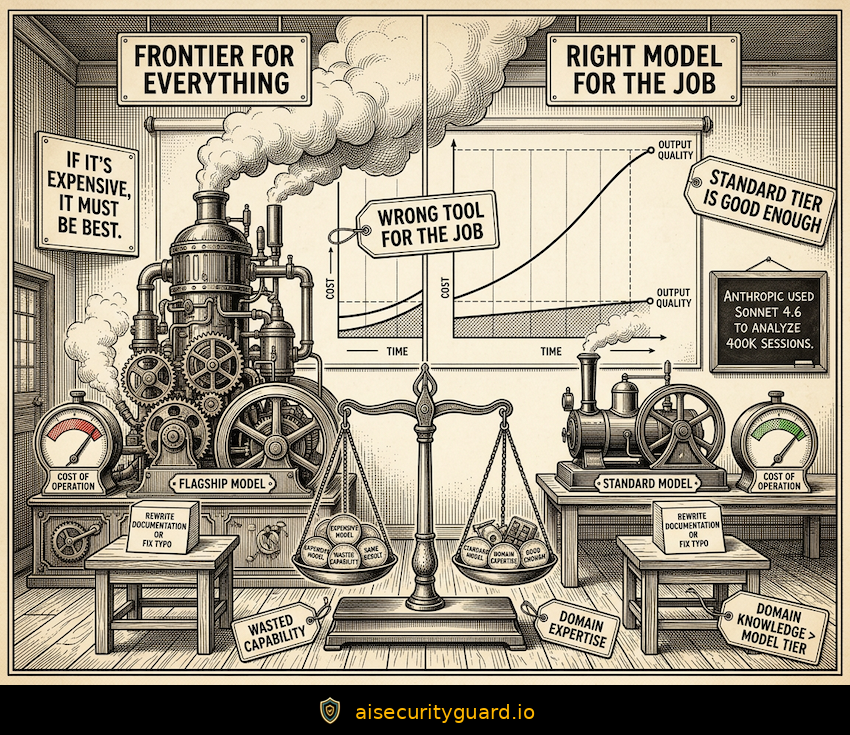
The logic goes that if the goal is quality, the flagship model will deliver the best results. But the data tells a different story. Anthropic used Claude Sonnet 4.6 — a standard-tier model — to classify and analyze more than 400,000 Claude Code sessions in their own research. The standard-tier model handled a sophisticated analytical task at scale, producing reliable outputs for complex work.
Anthropic's research also found that task success rates were heavily influenced by domain expertise, not model tier. Experts consistently achieved higher completion rates across all model tiers, while low-cost models delivered strong results on tasks where the user had relevant domain knowledge. Frontier models provide marginal gains for a small subset of complex tasks but are overkill for the majority.
Standard-tier models are good enough for most tasks. Reaching for flagship models for everything is not a quality strategy — it is a cost strategy in reverse, spending the most for outcomes that cheaper models could have delivered.