

LLM Loops: Expensive and Sometimes Ineffective
A common piece of advice in the agent optimization community is to let agents run in loops: send a prompt, read the output, check if the task is done, and repeat. The promise is that autonomous agents can work overnight, self-correct, and produce high-quality outputs without human intervention. "Set it and forget it," the advice goes.
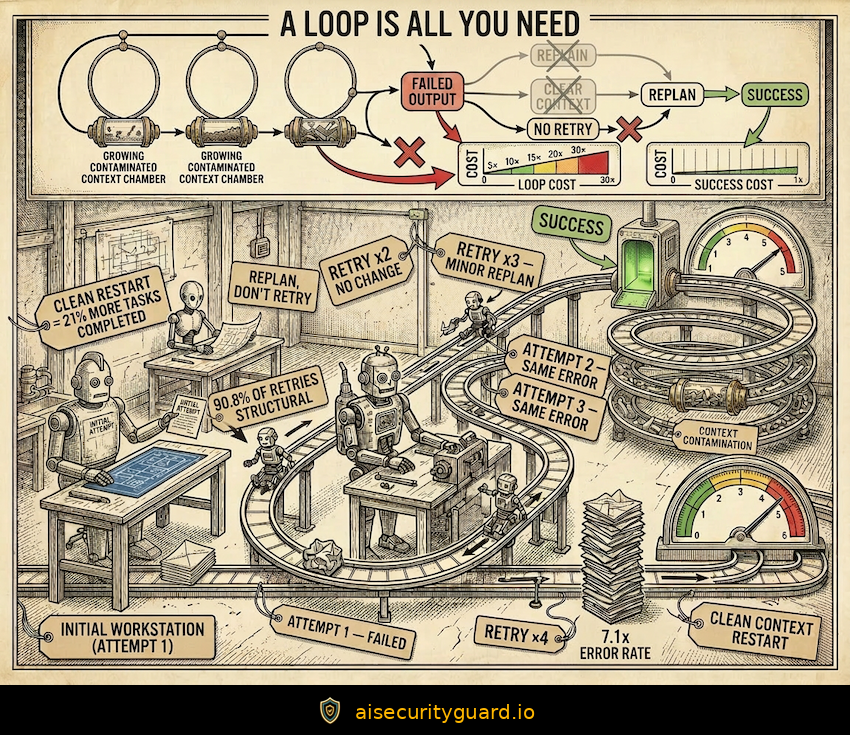
This advice sounds productive. It is not. Research on agentic systems shows that most retries are structural failures: when an agent's context becomes contaminated with failed tool outputs, stale instructions, or redundant context, the agent repeats the same actions that failed on the first attempt and cannot succeed on the tenth. More attempts is not a recovery strategy, it is an acceleration of the original failure.
Research on context contamination in multi-agent systems found that retrying with contaminated context elevates error rates 7.1× over clean-context restarts (Why Retrying Fails: Context Contamination in LLM Agent Pipelines). Another analysis of ReAct-style agents found that 90.8% of retries are structural failures: the agent is repeating an action that could not succeed on the first attempt and cannot succeed on the tenth (Why Most Agent Errors Aren't Transient).
The loop metaphor is seductive because it implies progress. But a loop with contaminated context is a circle of waste: each iteration burns more tokens at premium rates without moving closer to a successful outcome. The data shows that clean restarts with bounded retry budgets extract more value from each attempt than blind repetition.
The most efficient users treat retries as exceptions, not the default workflow. When a session fails, they clear context, replan the approach, and start fresh — rather than pushing the same lever harder.